
Technical guide
A/R Value in Twin-Scroll Turbocharger Housings
Updated 2025-04-10
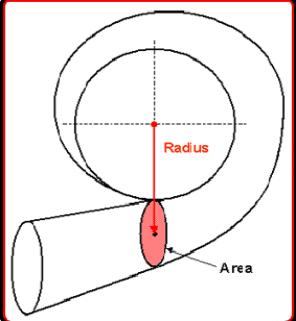
The A/R (Area/Radius) value is a crucial design parameter for turbocharger turbine housings, especially in twin-scroll configurations.
For a twin-scroll turbine housing:
- Definition:
- A = the cross-sectional area at the turbine housing inlet (volute throat area)
- R = the radius from the turbo's centerline to the centroid of that area
- A/R = The ratio between these two measurements (cm²/cm or in²/in)
- Twin-Scroll Specifics:
- Twin-scroll housings have two separate exhaust gas inlets (scrolls) that feed the turbine wheel
- Each scroll typically serves a specific group of cylinders (usually paired by firing order)
- The A/R value may be specified separately for each scroll or as an average
- Performance Impact:
- Lower A/R values create faster exhaust gas velocity, improving low-RPM response
- Higher A/R values reduce backpressure at high RPM, increasing top-end power
- Twin-scroll designs allow optimized A/R for both low-end and high-end performance
- Typical Values:
- Passenger cars: 0.4-0.6 (cm²/cm)
- Performance vehicles: 0.6-0.9
- The exact optimal value depends on engine displacement, desired powerband, and exhaust pulse separation needs
- Design Considerations:
- Must balance between pulse separation efficiency and flow characteristics
- Often uses divided A/R values where the initial section has a lower ratio than the merge point
- Modern designs may use variable A/R geometry for optimal performance across RPM ranges
The twin-scroll A/R value significantly affects turbo lag, boost threshold, and overall engine efficiency by optimizing exhaust energy utilization.
Here's how to calculate the A/R value for a twin-scroll turbocharger's turbine housing:
Calculation Method for Twin-Scroll A/R Value
The A/R (Area/Radius) ratio determines how efficiently exhaust gases accelerate toward the turbine wheel. For twin-scroll housings, the calculation follows the same principle as single-scroll turbos but may involve additional considerations due to the divided volute design.
1. Basic A/R Formula
A/R=Cross-Sectional Area (A)Radius to Centroid (R)A/R=Radius to Centroid (R)Cross-Sectional Area (A)
- A (Area) = The cross-sectional area of the volute throat (where exhaust enters the scroll)
- Measured perpendicular to the flow direction (typically in cm² or in²).
- For twin-scroll turbos, each scroll has its own A value (A₁ and A₂).
- R (Radius) = The distance from the turbo’s centerline (shaft axis) to the centroid (geometric center) of the throat area.
2. Steps to Measure A/R in a Twin-Scroll Housing
- Identify the Throat Section:
- Locate the narrowest point of each scroll’s inlet passage (before the volute expands).
- Twin-scroll turbos have two throats (one per scroll).
- Measure Cross-Sectional Area (A):
- For each scroll, calculate the throat area (A₁ and A₂).
- If the throat is circular: A=πr2 (where r = radius).
- If rectangular or irregular: Use CAD software or manual approximation (e.g., tracing and planimetry).
- Determine Radius (R):
- Measure the distance from the turbo’s centerline to the centroid of each throat area.
- For asymmetric designs, R may differ slightly between scrolls.
- Calculate A/R for Each Scroll:
- A/R1=A1/R1
- A/R2=A2/R2
- Twin-scroll turbos often aim for balanced A/R values between scrolls to ensure even exhaust pulse distribution.
- Combined A/R (Optional):
- Some manufacturers average the two:A/Ravg=(A1+A2)/(R1+R2)
- Others treat the twin-scroll as two separate A/R systems.
3. Practical Considerations for Twin-Scroll A/R
- Pulse Separation: Twin-scroll turbos pair cylinders to minimize interference. Uneven A/R values can disrupt exhaust pulse timing.
- Flow Bias: If one scroll has a higher A/R, it may cause uneven spooling or boost distribution.
- Manufacturing Tolerances: Small variations in A/R between scrolls are common but should be minimized.
4. Example Calculation
Assume a twin-scroll turbo with:
- Scroll 1: A1=5.0cm2, R1=8.0cm → A/R1=0.625
- Scroll 2: A2=4.8cm2, R2=7.9cm → A/R2=0.608
- Average A/R: (5.0+4.8)/(8.0+7.9)≈0.616
5. Tools for Measurement
- CAD Software: Best for precise area/radius calculations.
- Caliper/Protractor: For manual measurements (less accurate).
- Flow Benches: Validate A/R effects on actual flow dynamics.
Key Takeaway
Twin-scroll A/R calculation follows the same principles as single-scroll turbos but requires separate measurements for each scroll. Balanced A/R values optimize exhaust pulse utilization, reducing turbo lag and improving boost response.